
Different types of assistance dogs

Dogs perform many important functions in society, and there are many different kinds of working dogs. Assistance dogs enhances people’s lives through helping with tasks their person would have trouble completing on their own.
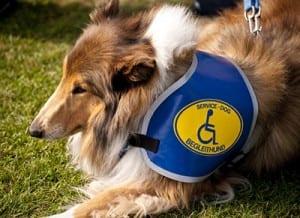
service dogAssistance dogs are divided into three categories:

Guide dogs  help the blind and visually impaired. These dogs help humans through guiding their handler past obstacles, stopping at stabs and curbs, and negotiating traffic. The handler gives commands, but it is the dog’s responsibility to ensure the team’s safety.

This type of job can be difficult and requires a lot from the dog, because doing the job to keep the handler safe can require disobeying direct commands.

Hearing dogs  help the deaf and heard of hearing. They assist through alerting their handlers to sound, and are trained to make physical contact with their handler, leading them to the source of the sound. These dogs are commonly trained to react to doorbells, alarm clocks, telephones, crying babies, and similar.

Service dogs  help people with other types of disabilities. Some are trained to work with wheelchairs, some are medical alert dogs, others help children with autism. There is a wide range of task performed by service dogs and they are often trained to open and close doors, turn on lights, bring objects, provide balance, and many other things.

Assistance groups are recognized by the ADA. Their handler have the right to bring them to any place that is open to the public

Pets gaining legal status in France

France has the biggest pet dog population in Europe with nearly 9 million dogs. Up until now, the country’s legal system has shared the view on pets held by many other countries including the USA; they are considered furniture that moves.

Most pet lovers would disagree with the description. It is apparent that pets have feelings, and they’re not furniture. Now a petition with 700,000 signatures has inspired a change in the French legal system, giving cats and dogs better legal protection from animal cruelty. The new ruling is also expected to help courts decide custody battles with pets involved.

The new legal status describes pets as “living beings capable of feelings.” This new stance might also have an impact on the treatment of other types of animals. Taken to the next level, it might affect animal testing and other areas.

Lilies and cats

Lilies are beautiful, and in springtime many yards hold an abundance of them. They’re also common in many Easter flower arrangements. While not particularly dangerous to humans or dogs, some types of lilies are poisonous to cats. This article will tell you what kinds are the most dangerous to cats, and what to watch out for.

Around Easter time, the Easter lily is a welcome guest in many homes. These flowers are very poisonous to cats, and it goes for every part of the plant. Leaves, petals, stems, and pollen are all poisonous. If you see your cat eating or licking an Easter lily, even if it’s just nibbling a leaf, call the vet. Cats can also accidentally ingest the pollen while grooming, and even such a small amount can lead to kidney failure.

Symptoms develop in six to twelve hours after exposure, and the signs of poisoning include:

  • Vomiting
  • Loss of appetite
  • Dehydration
  • Lethargy

Some cats also stagger, become disoriented, or suffer seizures.

Easter Lilies are dangerous to cats

If your cat ingested any part of an Easter lily, it needs treatment at once. There aren’t any antidotes to lily poison, and the vet will administer drugs to bind the poison and give intravenous fluids to flush out the kidneys. They will also monitor the kidneys through blood testing. If the cat gets treatment quickly, all this will be easier on both the pet and your wallet.

Other types of lilies known to be poisonous to cats include Tiger lilies – common in yards – Day lilies, and Asiatic lilies.

Amongst lilies that usually do not pose a problem to cats we find Peace lilies, Calla lilies, and Peruvian lilies.

It’s always a good idea to keep the numbers to your regular vet and pet emergency rooms saved in your phone and written down somewhere you can find it even in a time of stress.

Awards for Canine Excellence

The Awards for Canine Excellence – or ACE – are currently accepting nominations. The ACE awards are handed out by the AKC Humane Fund, and accepts nominations in five categories spanning over everything from family dogs to uniformed K-9.

Every entrant receives an AKC Humane Fund certificate of recognition. Some dogs will get an honorable mention, and this is awarded an engraved bronze medallion. The winner of each category receives a trip to the AKC/Eukanuba national championship in Orlando Florida, all expenses paid, $1,000 to a pet-charity of their choice, and a medal presented at an award ceremony.

To nominate a dog, follow this link and fill out the form.

The categories are:

Uniformed Service K-9
Dogs certified for law enforcement, military, and helping fire fighters.

Search and Rescue
Dogs certified to assist in tracking, locating missing people, natural disasters, etc.

Therapy Dogs
Dogs certified to provide comfort and affection to those in need.

Service Dogs
Dogs certified to help those with disabilities.

Exemplary companions
Dogs that are non-certified household pets.


Fun facts about cats

CatCats have excellent night vision, and can see well at one-sixth of the light level required for humans. They also have excellent hearing  and can hear higher-pitched sounds than both dogs and humans. The cat’s hearing is amongst the best of the mammals.

In addition to these great senses, cats have an acute sense of smell. It might not be as good as a blood-hound, but it’s still twice as good as a human’s.

When cats meet they don’t usually greet each other nose to nose, because that puts both participants in a vulnerable position. Cats who know each other well and have been apart for a while feel safe enough to do this, and through the nose contact they gather information about how the other cat is, where they have been, and what they have been doing.

Most human societies find it polite to meet another’s gaze. Cats do the opposite; they blink and narrow their eyes when they accidentally make eye contact. To make friends with an unfamiliar cat, try to blink and look away when you catch his eyes.

Get a food bowl that fits the size of your pet

Get the right size food bowlHave you ever noticed that if you put food on a big plate it looks so little, and by the time the plate is full, the portion is enough for dinner as well as lunch the next day? The same principle is true for dog bowls.  A big bowl makes a correct size portion look tiny, and it’s easy to put on too much.

In 2013, the University of Tennessee’s College of Veterinary Medicine made an experiment with 54 dogs and their owners. Four combinations were tested:

  • Small bowl with a small scoop
  • Small bowl with a large scoop
  • Large bowl with a small scoop
  • Large bowl with a large scoop

Just as one might guess, the servings in the small bowl with the small scoop were significantly smaller than all other combinations.

Does it matter?

Yes. Obesity is a health problem on the rise for pets as well as people, and keeping track of portions is especially important for pets eating dry food. Kibble is generally high in calories, and just a few extra pieces each day can make a small pet gain weight quickly.

Good ideas are to use a graded measuring cup, and to use the large bowl for water. Many pet owners have a small water bowl and a huge food bowl, but pets need much more water than they do food.

Everyday items that should be kept out of reach

Xylitol is poisonous to petsBy now most pet owners know dogs and cats shouldn’t have chocolate, raisins, onions, and macadamia nuts. Many other common every-day objects are also very dangerous to cats and dogs, and they’re so small and common it’s easy to forget they’re easily available in an open purse or on a table.

Human medications like Advil, Motrin, and Tylenol are present in almost every home, and very dangerous to pets. The acetaminophen in one Tylenol is enough to kill a cat or cause severe liver problems in a dog.

Asthma inhalers can also pose a problem if a pet chews on them. If a dog were to bite through the shell, the substance inside is enough to cause an acute, life-threatening poisoning.

Most chewing gums and mints contain xylitol. Xylitol is also common in chewable vitamins, sugar free candy, and nicotine gum. Xylitol is very toxic to dogs.

Also look out for all forms of nicotine. Cigarettes, smokeless tobacco, e-cigarette cartridges and fluid, nicotine gum, lozenges, anything with nicotine can potentially kill a pet.

Another common item that can be found in many cars, purses, and backpacks is hand sanitizer. These products contain lots of alcohol and can potentially cause coma and death in pets.

Prevention is naturally the best. Create good habits with putting potentially dangerous things away. If you still think your pet got into something poisonous, call your veterinarian at once. If the cat really ate something they shouldn’t have minutes can matter, and the sooner you get the correct diagnose the easier, safer, and less expensive it will be to treat your pet.

American pet spending still on the rise

The American Pet Products Association has kept records of US pet spending since 1996. Ever since then the industry has seen a steady growth of 4 to 6 percent per year.

In 2013, Americans spent $55.7 billion on their pets, and the number is expected to rise to $60 billion in 2014. If the trend stays as strong as during the past 18 years, we will see some 92 million American pet owners by 2018 that will spend at least $70 billion on pets, pet card, and pet products.

The biggest chunk of money in 2013 went to food. $21.6 billion fed our animal friends, and a large amount of it paid for healthier and more expensive food than in previous years.

Other highlights include $14.4 billion for veterinary care and $13.1 billion for supplies and over-the-counter medicines.


Cats and dogs may see flashes of light around power lines

A couple of weeks ago the PlexiDor blog reported about cats and dogs being able to see in ultraviolet. The ability makes it possible for many animals to see things humans do not, such as threats that would otherwise blend in with the environment and patterns that can lead to food. 

Being able to see like they see would probably be both convenient and amazing in many situations. Flowers, for instance, may have patterns we will never be able to discern. However, due to human interference the ability to see in ultraviolet might also be terrifying.

The Guardian reports that UV cameras can pick up coronal discharges around power lines that humans cannot see with the bare eye. These lights and flashes correspond with the humming we can sometimes hear around power lines.

Naturally, what we see with the aid of a camera is still not the same as animals able to detect ultraviolet frequencies would see, and the cameras can see a narrower range than most animals, but at least it gives us an idea.


We have known for a long time that animals in the wide prefer to avoid power lines, and the popular explanation has been that the corridors cut to accommodate the lines expose animals to predators. However, with power lines looking like glowing and flashing bands across the sky, they might have an unforeseen worldwide impact. Besides disturbing our domestic friends like cats and dogs, they might interfere with migration routes for birds and prevent mammals from going where they need to be.

Burying all power cables does not seem a realistic alternative, but one idea is to put a non-conducting shield around the cables to screen them from view.

Are there hypoallergenic dogs?

Hypoallergenic means that something is less likely to cause allergic reactions. It doesn’t mean that the food, pet, or rug never causes allergies. The word hypo means lower than normal.

So, are there hypoallergenic dog breeds?

Not really. There are hairless dogs and dogs that shed very little, but allergies aren’t necessarily connected to the pet’s coat. Most allergies are caused by proteins in a pet’s saliva and dander.

A study at the Henry Ford Hospital has analyzed dust samples collected from almost 200 homes. Sixty dog breeds were involved in the study, and eleven of the breeds are considered hypoallergenic.

The conclusion? There is no significant difference between breeds in how much allergens are produced. There can, however, be a difference between individuals of the same breed. Thus, a person with allergies can be able to have one specific pet, even if they’re allergic to other individuals of the same breed.

Most dog lovers will argue that pets are good for children. This is true when it comes to allergies as well; exposure to a dog early in life will provide a certain protection against developing dog allergies.

Some tips to battle allergies:

  • Bathe the pet often. This reduces the amounts of allergen related proteins on both the dog itself and in the air. If a person in the household is allergic, bathing the pet at least twice a week can minimize the allergic reaction.
  • Clean and vacuum often. Use air filters, and consider constricting the pet to certain rooms, so the allergic person can have a safe haven.
  • Smaller dogs might produce less allergens than larger dogs.
To read more about this subject, check out these links:

Pets are welcome

As society changes, pets are evolving into family members – a process called humanization – and a steadily increasing number of people choose to travel with their loved furry friends. According to the American Hotel and Lodging Association, 61% of hotels in the US now permit pets. 

Girl and dogOn the website Travelocity, more than 20,500 hotels are listed as pet friendly. The Kimpton Hotel and Restaurant Group estimates more than 100,000 pets stay in their 60 hotels each year, and 99% of these pets are dogs. The Essex Resort and Spa in Vermont has between 10 and 15 animals each night, and that makes up around 10% of their business.

Going back just a few years, pets could be allowed at a hotel, but people weren’t encouraged to bring them. This has also changed.

Today, many hotels welcome furry visitors with water bowls, pet-icures, dog Reiki, pet sitting, and more. It’s not just a gimmick; many hotels get a decent extra income from catering to pets. On the other hand, pet lovers can bring Speckles and Fido, and having the pet by one’s side provides company, comfort, joy, and freedom from worry.

If you’re looking for a pet-friendly hotel, the websites petswelcome.combringfido.com, andtripswithpets.com can assist in finding the right place.

PTSD amongst military dogs

Amongst 650 military dogs deployed with American combat forces nearly five percent came down with symptoms of Post Traumatic Stress Disorder. These dogs have been subjected to gunfire, explosions, and other combat scenarios, and react just like humans do.

Military veterinarians say it can show through dogs becoming clingy or aggressive, they might refuse to enter areas where they used to be comfortable, or become hyper-vigilent and set off alarms whether there’s something to worry about or not.

Dogs affected should be taken off their patrol duty, given lots of exercise, play time, and gentle obedience training.

Another similarity with humans is that dogs don’t have to go to war to enter a state of extreme stress. Other causes for PTSD in both species are natural disasters, car accidents, and physical or emotional trauma.

If you want to read more about dogs with PTSD, these websites provide a good starting point:

Sunshine story; police officer adopts five deaf dogs

A Virginia Detective, Mac Adams, has been involved with rescuing deaf dogs since 2010 when he adopted his dog Pickles from the Richmond Animal Care and Control. Since then, he has gotten four more; Nea, Piglet, Opal, and Mortimer.

Detective Mac Adams with his five deaf dogs. Photo from Facebook

Adams says there are 56 breeds of dogs prone to deafness. The puppies are born deaf and don’t know they’re supposed to hear, but it can be an obstacle in first figuring out a means of communication. Once the connection is made he thinks they pay a lot more attention to their person than hearing dogs, and might even be easier to train because they’re not distracted by sounds around them.

Four of the deaf dogs in the Adams’ household are Pitbulls, and he works on educating people about the breed. He says they are a great breed, generally gentle, calm, and good natured, but used for nefarious purposes by a small potion of the population.

Read more about Mac Adams and his dogs in this article on dogheirs.com.

Fun dog facts

Kooikerhondje

  • The Greyhound is considered the fastest dog on Earth. They can run 45 miles per hour.
  • The Irish Wolfhound is the largest dog breed.
  • The Great Dane is the tallest dog.
  • The Great Dane really originated in Germany, not in Denmark.
  • The Chihuahua is the smallest dog breed.
  • The St. Bernard is the heaviest dog breed.
  • The oldest dog in the world was an Australian cattle-dog named Bluey. He lived to be over 29 years.
  • Dogs have twice as many muscles for moving their ears as people.